
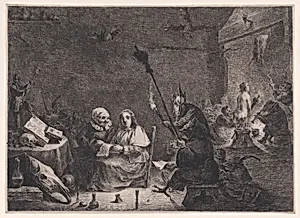
Departure for the Sabbath
Medium
Etching
Dimensions
20.9 x 28.9 cm.
Classification
Prints
Department
Drawings and Prints
Museum
Metropolitan Museum of Art, New York, NY
Credit
The Elisha Whittelsey Collection, The Elisha Whittelsey Fund, 1993
Accession Number
1993.1080
Rights
Public Domain
Tags
Art Historical Context
"Departure for the Sabbath" a captivating etching (20.9 x 28.9 cm) attributed to David Teniers the, with possible involvement from Baron Dominique Vivant Denon housed in the Metropolitan Museum of Art's Drawings and Prints. This print evokes the eerie world of witchcraft, featuring women—likely witches—alongside skulls, symbols of death and the supernatural. The title suggests a nocturnal gathering, a common motif in European art depicting the witches' sabbath, figures depart for mystical rites under the cover of darkness. David Teniers the Younger (1610–1690), a Flemish Baroque master, excelled in detailed genre scenes blending everyday life with fantastical elements, often rendered in small-scale works like this etching. Etching, an intaglio technique using acid to bite lines into a metal plate, allowed for the fine, expressive lines that capture the print's atmospheric tension and intricate details—perfect for conveying the macabre energy of skulls and spectral women. This artwork reflects 17th-century Europe's cultural obsession with witchcraft amid witch hunts and folklore, serving as both moral allegory and visual spectacle. As part of The Elisha Whittelsey Collection (acquired 1993), it invites visitors to ponder the blend of fear, fantasy, and artistry in prints that made the supernatural accessible to wide audiences.
About the Artist
David Teniers the Younger|baron Dominique Vivant Denon · 1610–1690
David Teniers the Younger (1610–1690) was a Flemish painter who became one of the most versatile and prolific artists of the seventeenth-century Southern Netherlands, renowned for his peasant genre scenes, elegant gallery paintings, and his role as court painter and curator. Born in Antwerp, he trained under his father, David Teniers the Elder, and was influenced by Adriaen Brouwer's peasant subje...