
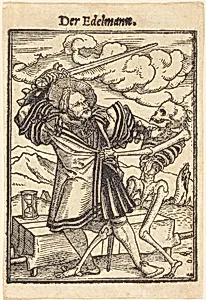
Der Edelmann (The Nobleman)
Medium
woodcut
Classification
Department
CG-E
Museum
National Gallery of Art, Washington, D.C.
Credit
Rosenwald Collection
Accession Number
1943.3.4837
Rights
Public Domain
Art Historical Context
**Der Edelmann (The Nobleman)**, a striking woodcut created around 1526, showcases the masterful collaboration between designer Hans Holbein the Younger woodcutter Hans Lütburger. Holbein, a leading figure of the Northern Renaissance was renowned for his precise lifelike portraits and intricate designs from his Basel workshop. Lützelburger, one of the era's finest block cutters, translated Holbein's drawings into woodblocks with extraordinary detail, elevating woodcuts from simple illustrations to works of fine art. This print captures the essence of early 16th-century European nobility, likely reflecting the social hierarchies of the Renaissance period amid the Reformation's upheavals. Woodcuts like this were revolutionary, allowing affordable reproduction and wide dissemination of sophisticated imagery—key to spreading humanist ideas and artistic innovation beyond elite patrons. Housed in the National Gallery of Art's Rosenwald Collection (Department CG-E), it exemplifies the technical prowess of the medium: fine lines incised into pearwood blocks, inked, and pressed onto paper for crisp contrasts and textures. Visitors will appreciate how *Der Edelmann* blends Holbein's observational realism with Lützelburger's precision, offering a window into the opulent attire and poised demeanor of a bygone elite. A testament to printmaking's golden age, it invites reflection on class, craftsmanship, and cultural exchange in Renaissance Europe.