
Derelitta
1860s
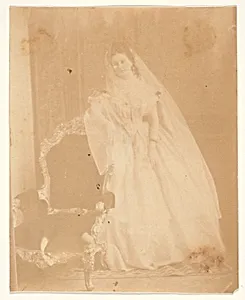
Medium
Albumen silver print from glass negative
Dimensions
7.8 x 9.5 cm. (3 1/16 x 3 3/4 in.)
Classification
Photographs
Department
Photographs
Museum
Metropolitan Museum of Art, New York, NY
Credit
David Hunter McAlpin Fund, 1975
Accession Number
1975.548.15
Rights
Public Domain
Tags
Art Historical Context
"Derelitta," a captivating albumen silver print from glass negative by Pierre-Louiserson, dates to the 1860s and measures a intimate 7.8 x 9.5 cm—perfectly sized for the era's popular cartes de visite, pocket-sized photographs exchanged like calling cards among Europe's elite. Pierson, a leading Parisian photographer associated with the Disdéri studio, specialized elegant portraits that captured the glamour and fantasy of Second Empire high society. This small-scale portrait of a woman exemplifies the technical precision of albumen prints, where a coating of egg white sensitized the paper to produce rich tones, sharp details, and a luminous quality that brought subjects vividly to life. The title "Derelitta," evoking abandonment or forsaken beauty in Italian, hints at a dramatic, theatrical pose typical of Pierson's innovative work. During the 1860s, photography transitioned from stiff daguerreotypes to more expressive portraits, often blending fashion, costume, and narrative flair. Pierson's images, now housed in The Metropolitan Museum of Art's Photographs Department (acquired via the David Hunter McAlpin Fund in 1975), reflect this shift, immortalizing women as muses in an age when photography democratized portraiture while elevating it to art. Today, "Derelitta" offers a window into 19th-century femininity and photographic innovation, reminding us how these tiny prints fueled celebrity culture and personal reinvention long before Instagram.
About the Artist
Pierre-Louis Pierson · 1822–1913
Pierre-Louis Pierson (1822–1913) was a pioneering French portrait photographer whose career spanned the formative years of the medium. Born on December 13, 1822, in Hinckange in the Moselle department, Pierson developed an early fascination with photography during the 1840s, as the daguerreotype was still in its infancy. His early life and formal training remain sparsely documented, but by 1844, h...