
Design for 4 seat Phaeton, no top, no. 3196a
1876
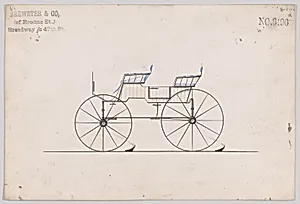
Medium
Pen and black ink, watercolor and gouache
Dimensions
Sheet: 6 1/8 x 9 1/16 in. (15.6 x 23 cm)
Classification
Drawings
Department
Drawings and Prints
Museum
Metropolitan Museum of Art, New York, NY
Credit
Gift of William Brewster, 1923
Accession Number
23.112.782
Rights
Public Domain
Tags
Art Historical Context
Step into the elegant world of 19th-century coachbuilding with *Design for 4 Seat Phaeton, no top, no. 3196a* by Brewster & Co., created in 1876. This delicate drawing on a modest 6 1/8 x 9 1/16-inch sheet captures the blueprint for a sleek, open-top phaeton—a light, four-wheeled carriage designed for passengers, prized for its speed and sporty appeal among America's elite. Rendered in pen and black ink with watercolor and gouache, it showcases the firm's meticulous attention to form and function. Brewster & Co., New York's premier carriage makers since 1810, crafted luxury vehicles for tycoons like the Vanderbilts during the Gilded Age. In 1876, amid post-Civil War prosperity, such phaetons symbolized status and leisure, blending British styling with American innovation before automobiles eclipsed them. This design reflects the height of horse-drawn elegance, where every curve and spoke was engineered for both beauty and performance. The mixed-media technique—precise ink lines heightened by vibrant washes—highlights the artistry in industrial design, turning technical sketches into promotional gems. A gift to the Metropolitan Museum of Art in 1923 from William Brewster, it preserves a vanishing craft, inviting us to admire the horsepower of a bygone era.
About the Artist
Brewster & Co. · 1837–present
**Brewster & Co.** Brewster & Company, a premier American coachbuilder renowned for its exquisite carriage designs, was established in 1810 in New Haven, Connecticut, by James Brewster (1788–1866). Born in 1788, Brewster trained as a wagonmaker's apprentice starting at age 16 in Northampton, Massachusetts, before relocating to New Haven, where he set up his workshop and quickly gained acclaim for...