
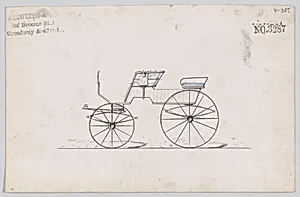
Design for 4 seat Phaeton, no top, no. 3287
1876
Medium
Pen and black ink, watercolor and gouache
Dimensions
Sheet: 5 3/4 x 8 7/8 in. (14.6 x 22.5 cm)
Classification
Drawings
Department
Drawings and Prints
Museum
Metropolitan Museum of Art, New York, NY
Credit
Gift of William Brewster, 1923
Accession Number
23.112.794
Rights
Public Domain
Tags
Art Historical Context
Step into the elegant world of 19th-century coachmaking with *Design for 4 Seataeton, no top, no. 3287* by Brewster & Co., a masterful 1876 rendering on a compact sheet measuring 5 3/4 x 8 7/8 inches. Crafted in pen and black ink with watercolor and gouache, drawing captures the sleek lines of an open, four-passenger phaeton—a lightweight, sporty carriage favored for leisurely drives. The "no top" design evokes breezy summer outings, highlighting the balance of form and function prized in high-end vehicles of the Gilded Age. Brewster & Co., New York's premier carriage makers from 1810 to 1930s, supplied luxury conveyances to presidents like Lincoln and Roosevelt, as well as Europe's elite. Created in 1876 amid America's post-Civil War boom, this design reflects the pinnacle of horse-drawn innovation just before automobiles loomed. Phaetons symbolized speed, status, and refined taste, blending engineering precision with ornamental flair. The artwork's mixed-media technique—crisp ink outlines paired with vibrant washes—allowed designers to pitch bespoke commissions vividly. Now in the Metropolitan Museum of Art's Drawings and Prints department, gifted by William Brewster in 1923, it offers a window into vanished equestrian culture, reminding us how such drawings bridged artistry and industry.
About the Artist
Brewster & Co. · 1837–present
**Brewster & Co.** Brewster & Company, a premier American coachbuilder renowned for its exquisite carriage designs, was established in 1810 in New Haven, Connecticut, by James Brewster (1788–1866). Born in 1788, Brewster trained as a wagonmaker's apprentice starting at age 16 in Northampton, Massachusetts, before relocating to New Haven, where he set up his workshop and quickly gained acclaim for...