
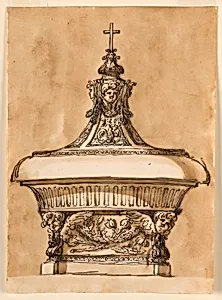
Design for a Baptismal Font
Medium
architecture
Classification
architecture
Department
Smithsonian Collection
Museum
Smithsonian American Art Museum
Credit
Museum purchase through gift of various donors and from Eleanor G. Hewitt Fund
Accession Number
1938-88-1423
Rights
Public Domain
About this artwork
Research in Progress
Art Historical Context
Giuseppe Barberi (1746–1809), a skilled Italian architect and designer, created this *Design for a Baptismal Font* around 1775, capturing the elegance of late 18th-century ecclesiastical architecture. Working in an era when Italy's artistic scene bridged Baroque opulence and emerging Neoclassicism, Barberi contributed to sacred furnishings that adorned churches across Rome and beyond. This architectural drawing or model reflects the meticulous planning required for functional yet ornate liturgical objects. Baptismal fonts, as vessels for the sacrament of baptism, held profound cultural and spiritual significance in Catholic tradition. Barberi's design likely emphasizes symbolic forms—perhaps chalice-like basins evoking renewal—tailored for church interiors. The architectural medium underscores the era's focus on harmonious proportions and durable materials, blending artistry with engineering for lasting religious spaces. Today, this piece resides in the Smithsonian American Art Museum, acquired through museum purchase and the Eleanor G. Hewitt Fund. Though research continues, it invites visitors to appreciate the transatlantic flow of European design traditions, highlighting Barberi's enduring influence on sacred architecture.