
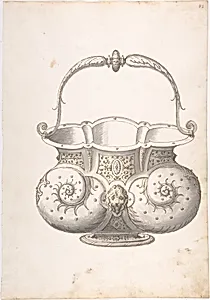
Design for a Bucket
16th century
Medium
Pen and brown and black ink, brush with gray and yellow wash over red chalk
Dimensions
16 7/16 x 11 7/16 in. (41.7 x 29.1 cm)
Classification
Drawings
Department
Drawings and Prints
Museum
Metropolitan Museum of Art, New York, NY
Credit
Bequest of Harry G. Sperling, 1971
Accession Number
1975.131.68
Rights
Public Domain
Tags
Art Historical Context
This exquisite 16th-century drawing *Design for a Bucket*, to Erasmus Hornick or an anonymous Flemish artist, offers a glimpse into Renaissance decorative arts. Created during a time when Northern European workshops buzzed with innovative designs for everyday objects, it depicts an ornate bucket—likely intended for metalwork like silver or brass—adorned with intricate motifs inspired by antiquity and nature. Hornick, active in Antwerp, was renowned for his engravings and ornamental patterns that bridged fine art and craft. The artwork showcases masterful techniques typical of the era: fine pen lines in brown and black ink define precise contours and elaborate scrollwork, while red chalk underdrawing provides a subtle structural foundation. Brush-applied gray and yellow washes add depth and luminosity, simulating the sheen of polished metal. At 16 7/16 x 11 7/16 inches, its scale suggests it was a presentation sheet for patrons or goldsmiths, highlighting the Renaissance fusion of utility and opulence. Housed in the Metropolitan Museum of Art's Drawings and Prints department through the bequest of Harry G. Sperling in 1971, this piece underscores the era's passion for vessels as status symbols. It invites us to appreciate how such designs elevated humble buckets into artistic treasures, blending functionality with fantastical embellishment.