
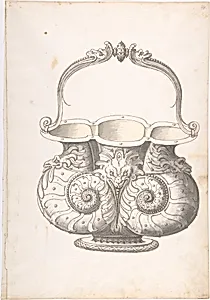
Design for a Bucket
16th century
Medium
Pen and black ink, brush with yellow and gray wash over traces of red and black chalk
Dimensions
16 7/16 x 11 1/2 in. (41.7 x 29.2 cm)
Classification
Drawings
Department
Drawings and Prints
Museum
Metropolitan Museum of Art, New York, NY
Credit
Bequest of Harry G. Sperling, 1971
Accession Number
1975.131.72
Rights
Public Domain
Tags
Art Historical Context
This exquisite *Design for a Bucket* from the 16th century, attributed Erasmus Hornick or an anonymous artist, offers a glimpse into Renaissance ornamental design. Created with pen and black ink, with yellow and gray wash traces of red and black, this drawing measures 16 7/16 x 11 1/2 inches and served as a blueprint for a functional yet elaborately decorated vessel. Likely intended for metalwork like silver or brass, it reflects the era's fascination with intricate patterns on everyday objects, blending utility with artistry. In 16th-century Europe, particularly in workshops of Antwerp or Germany where Hornick worked, such preparatory drawings were essential tools for goldsmiths and engravers. They translated complex motifs—possibly floral, grotesque, or strapwork—into precise instructions, bridging the gap between artist and craftsman. The layered technique here, with underdrawings in chalk for planning and washes for shading and highlights, showcases the meticulous skill needed to envision three-dimensional forms on paper. Housed in the Metropolitan Museum of Art's Drawings and Prints department through the bequest of Harry G. Sperling in 1971, this sheet highlights the unsung role of design drawings in the decorative arts. Visitors can appreciate how these humble sketches fueled the opulent metalware that graced Renaissance tables and homes, inviting us to imagine the gleaming bucket it inspired.