
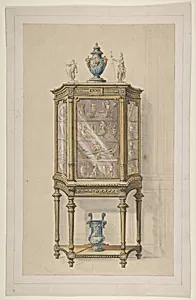
Design for a Cabinet with a Vitrine
ca. 1870–80
Medium
Graphite, pen and black ink, watercolor, gouache
Dimensions
11 7/8 x 7 3/16 in. (30.1 x 18.2 cm)
Classification
Drawings|Ornament & Architecture
Department
Drawings and Prints
Museum
Metropolitan Museum of Art, New York, NY
Credit
The Elisha Whittelsey Collection, The Elisha Whittelsey Fund, 1962
Accession Number
62.600.615
Rights
Public Domain
Tags
Art Historical Context
This exquisite design drawing by the Parisian firm A. Damon et., dated around 1870–80, captures the elegance of Second Empire luxury furniture. Titled *Design for a Cabinet with Vitrine*, it depicts refined cabinet topped with a glass-fronted display case, ideal for showcasing fine vases or collectibles. Created during France's post-Haussmann era of opulent interiors, such designs reflect the era's fascination with historicism, blending neoclassical motifs with intricate ornamentation to furnish the homes of the bourgeoisie and aristocracy. Rendered on a modest sheet of 11 7/8 x 7 3/16 inches, the work employs a masterful mix of media: graphite for preliminary sketches, pen and black ink for precise lines, and watercolor with gouache for vibrant color washes. This technique was standard for 19th-century ébénistes (cabinetmakers), allowing firms like Damon et Cie. to present vivid proposals to clients, bridging the gap between concept and craftsmanship. The drawing's survival in The Metropolitan Museum of Art's Elisha Whittelsey Collection highlights its role in preserving the creative process behind Europe's decorative arts boom. Today, it offers a window into how everyday luxury objects were conceptualized, emphasizing functionality alongside beauty—perfect for displaying cherished porcelain in a salon setting. A testament to the firm's skill, this piece invites us to appreciate the artistry behind the furniture we admire.