
Design for an Upright Drop-Front Secretary
ca. 1780
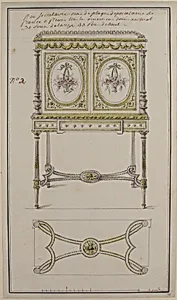
Medium
Pen and black ink, brush and gray and colored wash. Framing lines in pen and ink.
Dimensions
15 1/2 x 9 1/16 in. (39.4 x 23.0 cm)
Classification
Drawings
Department
Drawings and Prints
Museum
Metropolitan Museum of Art, New York, NY
Credit
Gift of Raphael Esmerian, 1959
Accession Number
59.611.4
Rights
Public Domain
Tags
Art Historical Context
This elegant design for an upright drop-front secretary captures the refined taste of late eighteenth-century French furniture making. Created around 1780 by an anonymous French draftsman, the drawing presents a tall, graceful secretary whose fall-front writing surface would open to reveal fitted drawers and compartments. Such pieces were prized in Parisian interiors for combining practical storage with refined ornament, reflecting the period’s emphasis on order, symmetry, and neoclassical detail. Executed in pen and black ink with delicate gray and colored washes, the sheet demonstrates the standard technique used by designers to communicate both structure and surface effects to cabinetmakers. The subtle coloring suggests the play of light on veneers, gilt-bronze mounts, and perhaps marble, allowing clients to envision the finished object before any wood was cut. Framing lines further present the design as a finished proposal rather than a casual sketch. Preserved in the Metropolitan Museum’s Department of Drawings and Prints, this work offers a rare glimpse into the collaborative process behind luxury furniture. Although the artist remains unknown, the drawing embodies the sophisticated visual language that helped define French decorative arts on the eve of the Revolution.
About the Artist
Anonymous, French, 18th century · 1700–1800
The artist known as Anonymous, French, 18th century, represents a collective of unidentified talents active roughly between 1700 and 1800, a period of profound artistic evolution in France from the opulent Rococo to the austere dawn of Neoclassicism and Revolutionary fervor. Little is documented about their personal training or mentors, as their anonymity obscures individual biographies, though th...