
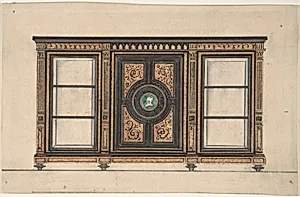
Design for a Cabinet with Portrait Rondel
19th century
Medium
Pen and ink and watercolor over graphite
Dimensions
sheet: 4 15/16 x 7 11/16 in. (12.5 x 19.5 cm)
Classification
Drawings|Ornament & Architecture
Department
Drawings and Prints
Museum
Metropolitan Museum of Art, New York, NY
Credit
The Elisha Whittelsey Collection, The Elisha Whittelsey Fund, 1959
Accession Number
59.608.70(12)
Rights
Public Domain
Tags
Art Historical Context
This delicate 19th-century British drawing captures the elegance of Victorian-era furniture craftsmanship, depicting a cabinet adorned with a central portrait rondel—a circular medallion likely intended for a painted or engraved likeness. Created anonymously, it exemplifies the preparatory sketches used by architects, designers, and cabinetmakers to ornate pieces, blending functionality with flair. Such cabinets were in middle- and upper-class homes for valuables, often showcasing intricate motifs that reflected personal or historical narratives. Executed in pen and ink with watercolor over graphite on a modest sheet (4 15/16 x 7 11/16 in.), the work highlights traditional drafting techniques: faint graphite underdrawings for precise proportions, bold ink outlines for structure, and subtle watercolor washes to evoke wood grains, gilding, and fabric textures. This layered method allowed designers to experiment affordably before committing to costly woodwork or metalwork, underscoring the era's revival of neoclassical and Gothic elements in domestic arts. Housed in the Metropolitan Museum of Art's Drawings and Prints department (The Elisha Whittelsey Collection, 1959), this artifact offers a window into Britain's booming furniture trade, where innovation met tradition to furnish the drawing rooms of the industrial age. A testament to unsung artisans, it invites us to appreciate the artistry behind everyday luxury.
About the Artist
Anonymous, British, 19th century · 1800–1900
**Anonymous, British, 19th century** is not the name of a single individual but a standard museum attribution used for works whose creators remain unidentified yet are clearly British and date to the 1800s. Major institutions, including the Metropolitan Museum of Art, employ this designation for hundreds of drawings, prints, designs, and decorative studies that lack signatures or firm documentary ...