
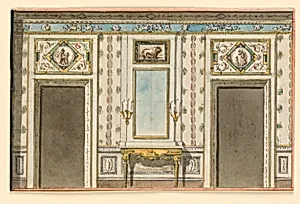
Elevation of a Wall
1790
Classification
drawing
Department
Smithsonian Collection
Museum
Smithsonian American Art Museum
Credit
Purchased for the Museum by the Advisory Council
Accession Number
1911-28-429
Rights
Public Domain
About this artwork
Research in Progress
Art Historical Context
**Elevation of a Wall** *Unknown artist, 1790* Drawing, Smithsonian American Art Museum Step into the world of late 18th-century American design with *Elevation of a Wall*, precise architectural drawing from 1790. Created during the early years of the United States, just a decade after independence, this work captures the era's fervor for nation-building. Architects and builders were drafting grand visions for public buildings and homes inspired by classical European styles, adapted to the new republic's ideals of democracy and symmetry. As an "elevation"—a technical view showing the front face of a wall—this drawing likely served as a blueprint, guiding construction with exact proportions and details. Though the artist remains unknown and research continues, its presence in the Smithsonian American Art Museum highlights everyday artifacts of American ingenuity. Purchased by the Advisory Council, it reflects how drawings like this fueled the Federal style's rise, blending practicality with elegance. Imagine carpenters and masons poring over such sketches to erect enduring structures—symbols of a young nation's ambition. This piece invites us to ponder the unsung hands behind America's architectural heritage, reminding visitors that even anonymous works shape our shared history. (178 words)
About the Artist
Unknown
The artist designated as "Unknown" in our virtual museum's collection exemplifies a poignant chapter in art history: creators whose identities have faded into obscurity despite the enduring power of their work. With only one known artwork attributed to them in our holdings, this figure represents countless anonymous hands that shaped visual culture across centuries. Museums worldwide, including th...