
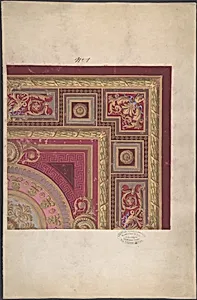
Design for a Carpet
19th century
Medium
Pen and black ink, gouache
Dimensions
sheet: 10 9/16 x 10 9/16 in. (26.8 x 26.8 cm)
Classification
Drawings
Department
Drawings and Prints
Museum
Metropolitan Museum of Art, New York, NY
Credit
Gift of the Royal Institute of British Architects, 1961
Accession Number
61.669.44
Rights
Public Domain
Tags
Art Historical Context
This delicate "Design for a Carpet," created by an anonymous French artist in the 19th century, exemplifies the meticulous world of ornamental drafting during France's golden age of decorative arts Rendered in pen and black ink with vibrant gouache on a perfectly square 10 9/16 x 10 9/16-inch sheet, it served as a blueprint for textile production, likely intended for luxurious woven carpets. The use of gouache—a opaque watercolor—allowed for bold, saturated colors and precise shading, making it ideal for visualizing intricate patterns that weavers would later interpret in wool or silk. In the 19th century, France led Europe in opulent interior design, fueled by the Napoleonic revival and the rise of historicism. Carpet designs like this reflected a fascination with floral motifs, arabesques, and geometric repeats, drawing from Renaissance and Oriental influences amid the era's industrial textile boom. Such preparatory drawings were essential in workshops like those of Aubusson or the Gobelins, bridging artistry and craftsmanship. Today, housed in the Metropolitan Museum of Art's Drawings and Prints department (gift of the Royal Institute of British Architects, 1961), this anonymous gem highlights the unsung role of designers in shaping everyday luxury. Its ornamental tag underscores a timeless appeal: patterns that transform floors into canvases of elegance.
About the Artist
Anonymous, French, 19th century · 1800–1900
**Anonymous, French, 19th Century (ca. 1800–1900)** The artist cataloged as Anonymous, French, 19th century embodies the enigmatic yet essential contributions of unidentified creators to France's vibrant 19th-century art world. Active roughly between 1800 and 1900, this figure—or potentially collective workshop—produced a diverse array of works amid the nation's transition from Neoclassicism thro...