
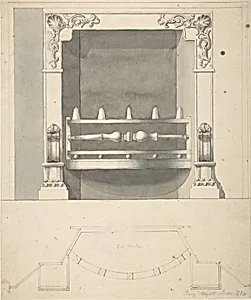
Design for a Cast-iron Hob Grate in Ormolu
Medium
Pen and ink, brush and wash, yellow watercolor
Dimensions
sheet: 8 x 7 1/2 in. (20.3 x 19 cm)
Classification
Drawings|Ornament & Architecture
Department
Drawings and Prints
Museum
Metropolitan Museum of Art, New York, NY
Credit
The Elisha Whittelsey Collection, The Elisha Whittelsey Fund, 1956
Accession Number
56.500.67(2)
Rights
Public Domain
Tags
Art Historical Context
In 1814, during the elegant Regency era in Britain, architect Benjamin Dean Wyatt created this exquisite design for a cast-iron hob grate finished in ormolu—a luxurious gilding technique using ground gold over bronze or brass. Wyatt, renowned for his neoclassical projects like the Drury Lane Theatre, specialized in blending classical motifs with practical domestic architecture. This drawing captures the refined ornamental details of a fireplace grate, essential for heating grand Georgian and Regency homes, where hearths were both functional and statements of status. Rendered on a compact 8 x 7½-inch sheet, the work employs precise pen and ink lines for structure, enhanced by brush and wash for depth and subtle yellow watercolor to evoke the warm glow of ormolu. Such mixed-media techniques were standard for architectural draftsmen, allowing Wyatt to convey texture, shadow, and metallic sheen to craftsmen, ensuring accurate replication in cast iron—a durable, affordable material elevated by opulent finishes. Housed in the Metropolitan Museum of Art's Drawings and Prints department, this piece highlights the artistry behind everyday opulence, bridging architecture and ornament. It offers a glimpse into Regency design's fusion of utility and grandeur, reminding us how even a humble grate could embody neoclassical splendor.