
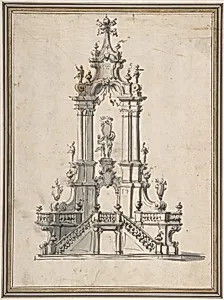
Design for a Catafalque
Medium
Brown ink and wash
Dimensions
10-13/16 x 7-7/8 in
Classification
Drawings|Ornament & Architecture
Department
Drawings and Prints
Museum
Metropolitan Museum of Art, New York, NY
Credit
The Elisha Whittelsey Collection, The Elisha Whittelsey Fund, 1968
Accession Number
68.638.1
Rights
Public Domain
Tags
Art Historical Context
This delicate drawing, titled *Design for a Cataque*, hails from an anonymous Bolognese artist of the 18th century a period when Bologna flourished as a hub for architectural innovation and ornate decorative arts in Italy. A catafalque was an elaborate temporary platform used to display a coffin during funerals, often for nobility or clergy, transforming solemn rites into grand spectacles of draped fabrics, columns, and symbolic motifs. This design exemplifies the Baroque-influenced Bolognese tradition of theatrical ornamentation, where architecture blurred into ephemeral performance. Rendered in brown ink and wash on paper (measuring 10-13/16 x 7-7/8 inches), the work showcases a masterful use of wash technique—a diluted ink application that builds subtle tonal gradients, lending three-dimensional depth and dramatic chiaroscuro to the structure's contours. Such preparatory drawings were essential tools for architects and designers, allowing visualization of complex, site-specific installations before construction. Housed in the Metropolitan Museum of Art's Drawings and Prints department, this piece from The Elisha Whittelsey Collection highlights the cultural reverence for death rituals in 18th-century Italy. It invites us to ponder how art elevated mourning into a communal art form, blending engineering precision with emotional grandeur.