
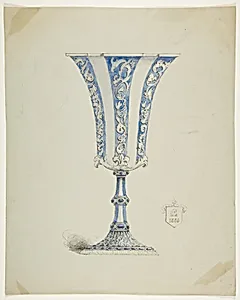
Design for a Chalice
Medium
Pen and black ink, brush and blue wash, heightened with white, over graphite
Dimensions
sheet: 12 1/2 x 10 in. (31.7 x 25.4 cm)
Classification
Drawings
Department
Drawings and Prints
Museum
Metropolitan Museum of Art, New York, NY
Credit
The Elisha Whittelsey Collection, The Elisha Whittelsey Fund, 1962
Accession Number
62.659.78
Rights
Public Domain
Tags
Art Historical Context
This delicate *Design for a Chalice created anonymously by a French artist in 185, offers a glimpse into the meticulous world of 19th decorative arts. Rendered on a sheet measuring 12½ x 10 inches, drawing depicts an ornate chalice, likely for liturgical or ceremonial use, adorned with ornamentation and insignia. Such designs were essential preparatory works, bridging the gap between artistic conception and craftsmanship in goldsmithing or silversmithing workshops during France's Second Empire era, a time of renewed interest in opulent religious artifacts amid Gothic Revival influences. The medium—pen and black ink with brush and blue wash, heightened with white over graphite—showcases advanced drafting techniques favored by designers of the period. The blue wash provides subtle tonal modeling, while white heightening adds luminous highlights, mimicking the sheen of polished metal. This layered approach allowed artists to convey texture, volume, and reflective qualities, helping artisans visualize the final three-dimensional object. Housed in the Metropolitan Museum of Art's Drawings and Prints department as part of The Elisha Whittelsey Collection, it exemplifies the precision and elegance of French ornamental drafts from the mid-1800s. For visitors, this anonymous gem highlights how everyday sketches fueled grand creations, blending functionality with symbolic grandeur in objects central to ritual and devotion.
About the Artist
Anonymous, French, 19th century · 1800–1900
**Anonymous, French, 19th Century (ca. 1800–1900)** The artist cataloged as Anonymous, French, 19th century embodies the enigmatic yet essential contributions of unidentified creators to France's vibrant 19th-century art world. Active roughly between 1800 and 1900, this figure—or potentially collective workshop—produced a diverse array of works amid the nation's transition from Neoclassicism thro...