
Design for a Chimneypiece with Ionic columns, a Frieze, and Cornice
1743–96
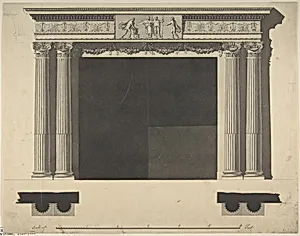
Medium
Pen and brown ink, brush and gray wash, over graphite
Dimensions
sheet: 11 1/4 x 14 5/16 in. (28.5 x 36.4 cm)
Classification
Drawings|Ornament & Architecture
Department
Drawings and Prints
Museum
Metropolitan Museum of Art, New York, NY
Credit
Harris Brisbane Dick Fund, 1934
Accession Number
34.78.2(6)
Rights
Public Domain
Tags
Art Historical Context
Sir William Chambers, a leading neoclassical architect of the th century, created this exquisite design for a chimneypiece around the mid-1700s, during his formative years studying classical architecture on the Grand Tour of Europe. Born in Sweden to Scottish parents, Chambers rose to prominence in Britain, designing landmarks like Somerset House and the Kew Gardens pagoda. This drawing exemplifies his passion for antiquity, featuring Ionic columns—slender and elegant with volute capitals—flanked by a detailed frieze and cornice, evoking the grandeur of ancient Roman and Greek fireplaces adapted for Georgian interiors. Rendered in pen and brown ink with brush and gray wash over graphite on a modest 11¼ x 14½-inch sheet, the work showcases Chambers' precise drafting technique. Graphite underdrawing allowed for initial sketches, while ink lines defined crisp architectural details, and gray wash added subtle shading to suggest depth, texture, and light play on carved stone. Such preparatory drawings were essential tools for architects, bridging imagination and execution in an era when neoclassicism emphasized symmetry, proportion, and ornament drawn from Vitruvian principles. Housed in the Metropolitan Museum of Art's Drawings and Prints department, this piece highlights the fusion of art and architecture, offering visitors a window into how elite 18th-century homes blended functionality with classical splendor. Imagine the flickering firelight dancing across these ornate elements in a London townhouse!
About the Artist
Sir William Chambers · 1723–1796
### Sir William Chambers (1723–1796) Born on 23 February 1723 in Gothenburg, Sweden, to parents of Scottish descent—his father a merchant—Sir William Chambers embarked on an extraordinary path that bridged continents and cultures. At just 16, after initial education in England, he joined the Swedish East India Company, undertaking three voyages to China in the 1740s. These journeys profoundly sha...