
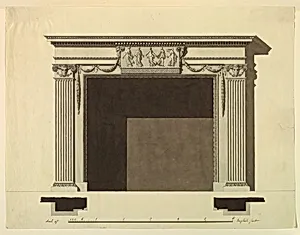
Design for a Chimneypiece with Borghese Dancers
1780–1800
Classification
Drawing
Department
Smithsonian Collection
Museum
Smithsonian American Art Museum
Credit
Museum purchase through gift of various donors and from Eleanor G. Hewitt Fund
Accession Number
1938-88-8202
Rights
Public Domain
About this artwork
Research in Progress
Art Historical Context
This delicate drawing, titled *Design for a Chimneiece with Borghese D*, dates to the late 18 or early 19th (1780–1800) and captures the neoclassical fascination with ancient Rome. A chimneypiece, or ornate fireplace mantel, was a of grand interiors during this era, blending functionality with opulent decoration. Here, the unknown artist incorporates the iconic "Borghese Dancersfigures inspired by lively ancient Roman reliefs on a 2nd-century sarcophagus the Borghese Villa in Rome. These joyful, flowing dancers symbolized classical revelry and were widely reproduced in European design, reflecting the Enlightenment-era revival of Greco-Roman motifs. As a preparatory drawing from the Smithsonian American Art Museum's collection, it highlights the meticulous planning behind architectural ornamentation. Such designs guided craftsmen in carving stone or wood, ensuring symmetry and grandeur in homes of the elite. Though the exact medium remains unidentified amid ongoing research, drawings like this were essential tools in workshops, allowing artists to experiment with proportion and narrative before execution. Acquired through museum purchase and donors including the Eleanor G. Hewitt Fund, this work offers a window into transatlantic tastes, bridging European classicism with emerging American aesthetics. It invites us to imagine flickering hearth fires illuminating these timeless dancers in a bygone salon.
About the Artist
Unknown
The artist designated as "Unknown" in our virtual museum's collection exemplifies a poignant chapter in art history: creators whose identities have faded into obscurity despite the enduring power of their work. With only one known artwork attributed to them in our holdings, this figure represents countless anonymous hands that shaped visual culture across centuries. Museums worldwide, including th...