
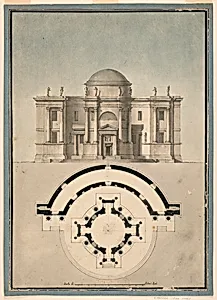
Design for a Classical Temple with a Tempietto and Semicircular Aedicule
ca. 1780
Classification
architecture
Department
Smithsonian Collection
Museum
Smithsonian American Art Museum
Credit
Museum purchase through gift of various donors and from Eleanor G. Hewitt Fund
Accession Number
1938-88-7158
Rights
Public Domain
About this artwork
Research in Progress
Art Historical Context
This exquisite architectural design, titled *Design for a Classical Temple a Tempietto andemicircular Aedicule hails from Italy around 1780. Created by an unknown artist, it captures the Neoclassical fervor of the late Enlightenment era, when architects and designers across Europe revived the grandeur of ancient Roman and Greek temples. The composition features a central tempietto—a small, ornate temple pavilion—flanked by a semicircularedicule, a recessed niche framed like a miniature shrine, evoking the harmonious proportions and classical orders beloved by architects of the time. In the context of 18th-century Italy, such designs reflected a deep scholarly engagement with antiquity, fueled by archaeological discoveries at sites like Pompeii and Herculaneum. These drawings often served as proposals for gardens, villas, or public monuments, blending utility with poetic idealism. Though the medium remains unidentified—likely ink, wash, or etching on paper—this work exemplifies the precision and elegance of Italian architectural drafting, prioritizing symmetry, pediments, and columnar motifs. Now part of the Smithsonian American Art Museum's collection, acquired through generous donors and the Eleanor G. Hewitt Fund, this piece invites ongoing research into its origins and influences. It reminds us how 18th-century visions of classical perfection continue to inspire modern architecture, bridging centuries with timeless beauty.