
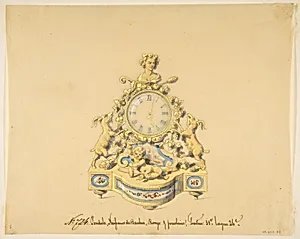
Design for a Clock: Birth of Bacchus
19th century
Medium
Graphite, brush and gray wash, watercolor, and gouache
Dimensions
sheet: 8 15/16 x 11 1/4 in. (22.7 x 28.5 cm)
Classification
Drawings
Department
Drawings and Prints
Museum
Metropolitan Museum of Art, New York, NY
Credit
The Elisha Whittelsey Collection, The Elisha Whittelsey Fund, 1953
Accession Number
53.675.37
Rights
Public Domain
Tags
Art Historical Context
This delicate 19th-century French for a clock, titledBirth of Bacchus*, a mythological moment from classical antiquity: the god of wine emerging triumphantly from Zeus's thigh Created anonymously by a skilled draftsman, the sheet—measuring about 9 by 11 inches—serves as a preparatory study for an ornate timepiece, blending whimsy with grandeur. Housed in the Metropolitan Museum Art's Drawings and Prints, it reflects the era's fascination with Greco-Roman myths, often revived in decorative arts during France's Romantic and Empire periods to evoke luxury and storytelling. The mixed-media technique showcases masterful versatility: graphite for precise lines, brush and gray wash for subtle shading and depth, watercolor for translucent hues, and gouache for bold, opaque accents. These methods, common in 19th-century design ateliers, allowed artists to simulate the final object's gleam—perhaps gilded bronze or enamel—while testing compositions for clock faces or cases. Such drawings were essential blueprints for luxury craftsmen, bridging fine art and functional objects. As part of The Elisha Whittelsey Collection, this work highlights the artistry behind everyday elegance, inviting us to ponder how myths like Bacchus's birth adorned 19th-century salons, marking time with a touch of divine revelry.
About the Artist
Anonymous, French, 19th century · 1800–1900
**Anonymous, French, 19th Century (ca. 1800–1900)** The artist cataloged as Anonymous, French, 19th century embodies the enigmatic yet essential contributions of unidentified creators to France's vibrant 19th-century art world. Active roughly between 1800 and 1900, this figure—or potentially collective workshop—produced a diverse array of works amid the nation's transition from Neoclassicism thro...