
Design for a Clock with a Classical Female Figure
ca. 1800
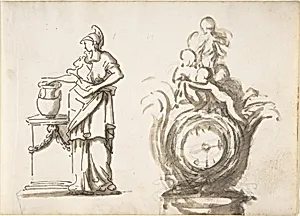
Medium
Graphite, pen and brown ink, brush and brown wash
Dimensions
5 5/16 x 7 3/8 in. (13.5 x 18.7 cm)
Classification
Drawings
Department
Drawings and Prints
Museum
Metropolitan Museum of Art, New York, NY
Credit
The Elisha Whittelsey Collection, The Elisha Whittelsey Fund, 1966
Accession Number
66.551.16
Rights
Public Domain
Tags
Art Historical Context
This delicate design drawing captures the elegance of Neoclassical taste at the turn of the nineteenth century. Created around 1800 by an anonymous French artist, it presents a graceful female figure in classical drapery, likely intended as the central ornament for a mantel or table clock. Such timepieces were prized symbols of refinement in French households, blending functionality with sculptural beauty inspired by ancient Greece and Rome. Executed in graphite, pen, and brown wash, the sketch reveals the careful planning behind decorative objects of the period. The fluid lines and subtle shading demonstrate how designers explored proportion, movement, and ornament before pieces were cast in bronze or gilded. Though modest in scale—just over five by seven inches—the drawing offers a window into the collaborative world of artisans, clockmakers, and patrons during the Consulate era. Acquired by the Metropolitan Museum in 1966, this work highlights the often-unseen creative process behind the luxurious furnishings that defined French interiors. It reminds viewers that even functional objects like clocks were conceived as works of art, embodying the era’s admiration for harmony, clarity, and classical ideals.
About the Artist
Anonymous, French, 18th century · 1700–1800
The artist known as Anonymous, French, 18th century, represents a collective of unidentified talents active roughly between 1700 and 1800, a period of profound artistic evolution in France from the opulent Rococo to the austere dawn of Neoclassicism and Revolutionary fervor. Little is documented about their personal training or mentors, as their anonymity obscures individual biographies, though th...