
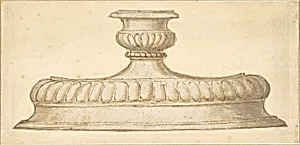
Design for a Decorated Base of a Candlestick Holder
early 16th century
Medium
Pen and brown ink, brush and brown wash. Design silhouetted
Dimensions
sheet: 2 13/16 x 5 7/8 in. (7.1 x 15 cm)
Classification
Drawings|Ornament & Architecture
Department
Drawings and Prints
Museum
Metropolitan Museum of Art, New York, NY
Credit
The Elisha Whittelsey Collection, The Elisha Whittelsey Fund, 1949
Accession Number
49.50.199
Rights
Public Domain
Tags
Art Historical Context
This delicate design for the base of a candlestick holder, created by Giulio Romano in the early sixteenth century, offers a fascinating glimpse into the ornamental imagination of the Renaissance. Giulio, a leading figure in the Mannerist movement and former assistant to Raphael, brought a sculptural sensibility to his architectural and decorative projects. Here, the artist envisions an elaborate base adorned with intricate motifs, transforming a functional object into a work of art that would have graced the tables or altars of noble patrons. Executed in pen and brown ink with brush and brown wash, the drawing’s silhouetted form highlights the careful attention paid to outline and shadow, allowing the design to stand out vividly against the paper. Such preparatory studies were essential tools for artists and craftsmen, bridging the gap between two-dimensional ideas and three-dimensional metalwork or carved objects. Today housed in the Metropolitan Museum of Art’s Department of Drawings and Prints, this small sheet—measuring just over five inches wide—reminds us how even the most utilitarian items could embody the period’s pursuit of beauty and refinement.
About the Artist
Giulio Romano · 1499–1546
Giulio Romano (c. 1499–1546) was the most gifted pupil of Raphael and one of the founding figures of Mannerism, the style that succeeded the High Renaissance in Italy. Born Giulio Pippi in Rome, he entered Raphael's workshop as a boy and proved so talented that by the time of Raphael's death in 1520 he was effectively running the studio and overseeing the completion of major unfinished commissions...