
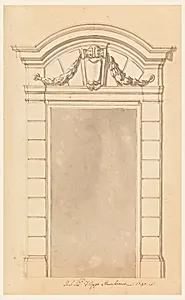
Design for a door case
Medium
architecture
Classification
architecture
Department
Smithsonian Collection
Museum
Smithsonian American Art Museum
Credit
Museum purchase through gift of various donors
Accession Number
1901-39-2163
Rights
Public Domain
About this artwork
Research in Progress
Art Historical Context
Filippo Marchionni's *Design for a Door Case (ca. 1740) offers a glimpse into the elegant architectural imagination of 18th-century Italy. Born in Rome in 1732, Marchionni was a prolific architect whose early career bridged the ornate Baroque and emerging Rococo styles, before he championed Neoclassicism in grand projects like the Palazzo Doria Pamphilj. This preparatory design, likely a detailed drawing or plan, captures the meticulous planning essential to creating harmonious door surrounds—key features that framed entrances in palaces and villas, blending functionality with opulent decoration. Created when Marchionni was still a young talent, the work reflects the period's emphasis on proportion, symmetry, and decorative flourish, where door cases served as dramatic transitions between public and private spaces. Architectural designs like this were vital tools for patrons, allowing architects to refine ideas on paper before costly construction. Acquired through museum purchase with donor gifts, it now resides in the Smithsonian American Art Museum's architecture collection, highlighting transatlantic appreciation for European design influences on American tastes. Though research continues, this piece invites visitors to ponder how such intricate concepts shaped lived spaces, evoking the grandeur of Italy's golden age of architecture.