
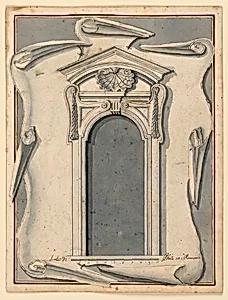
Design for a Door Frame
Classification
architecture
Department
Smithsonian Collection
Museum
Smithsonian American Art Museum
Credit
Museum purchase through gift of various donors
Accession Number
1901-39-632
Rights
Public Domain
About this artwork
Research in Progress
Art Historical Context
Nestled in the Smithsonian American Art Museum's collection *Design for a Door Frame by Italian architect Carlo Marchionni1702–1786) dates to the mid-18th century (1740–60).ionni, a prominent figure in Roman architecture during the Late Baroque era, contributed to grand projects like the Palazzo Doria Pamphilj and Trevi Fountain's design circle. This architectural drawing exemplifies the era's emphasis on ornate, sculptural doorways as dramatic entry points in palaces and villas, blending functionality with lavish decoration. Door frames like this one served as canvases for artistic expression, often featuring intricate moldings, scrolls, and figural motifs that drew viewers into a space. Though the medium remains unidentified amid ongoing research, such designs were typically rendered in pen, ink, and wash on paper, allowing architects to refine proportions and embellishments before execution in stone or stucco. Marchionni's work reflects Italy's transition from exuberant Baroque to more refined Rococo influences, showcasing his mastery of spatial drama. Acquired through museum purchase with donor gifts, this piece invites us to ponder the hidden artistry behind everyday thresholds. As research progresses, it reminds visitors of architecture's power to elevate the ordinary into the extraordinary.