
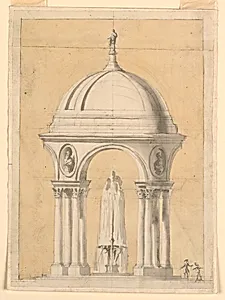
Design for a Fountain in a Pavilion
Classification
architecture
Department
Smithsonian Collection
Museum
Smithsonian American Art Museum
Credit
Museum purchase through gift of various donors and from Eleanor G. Hewitt Fund
Accession Number
1938-88-2126
Rights
Public Domain
About this artwork
Research in Progress
Art Historical Context
**Design for a Fountain in Pavilion** by Carlo Francesco Barabino (, 1768–1835) offers a glimpse into late 18th-century Italian architectural imagination. Created between 1785 and 1790, when Barabino was just teenager embarking on his career, this design envisions an elegant fountain set within a pavilion—a refined garden structure blending utility and ornament. Acquired by the Smithsonian American Art Museum through museum purchase and donor gifts, including the Eleanor G. Hewitt, it highlights cross-cultural exchanges in art collecting. As an architectural drawing (medium details under ongoing research), the work reflects Italy's rich tradition of integrating water features into landscapes, evoking the grandeur of Renaissance and Baroque gardens while nodding to emerging Neoclassical restraint. Pavilions like this served as serene retreats in estates, symbolizing harmony with nature and classical ideals. Barabino, later renowned for Genoese public buildings, showcases early promise here, making this piece a rare survivor of youthful creativity now treasured in an American collection. Though research continues, its presence invites us to ponder how such designs shaped Europe's leisurely spaces—and why they captivated collectors across the Atlantic. (198 words)