
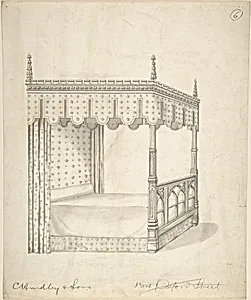
Design for a Gothic Bed with Canopy
1841–84
Medium
Pen and black ink
Dimensions
sheet: 11 1/4 x 9 5/16 in. (28.6 x 23.6 cm)
Classification
Drawings|Ornament & Architecture
Department
Drawings and Prints
Museum
Metropolitan Museum of Art, New York, NY
Credit
Harris Brisbane Dick Fund, 1946
Accession Number
46.38.68
Rights
Public Domain
Tags
Art Historical Context
This delicate pen and black ink drawing, titled *Design for a Gothic Bed with Can*, comes from the London firm Charles Hindley and, active between 1841 and 1884. Created on a modest sheet measuring 11¼ x 9⅜ inches, it exemplifies the precision of 19th-century design sketches used by furniture makers to propose elaborate pieces for wealthy clients. Hindley and Sons specialized in high-end furnishings, blending functionality with ornate decoration. The design reflects the Gothic Revival movement, a Victorian fascination with medieval architecture popularized by designers like A.W.N. Pugin. Amid the Industrial Revolution's mass production, such beds evoked chivalric romance, with pointed arches, tracery, and canopies transforming bedrooms into Gothic sanctuaries. Pen and ink allowed for intricate line work, capturing fine details like carved finials and paneling that would be executed in wood or upholstery. Housed in the Metropolitan Museum of Art's Drawings and Prints department, this work highlights how ornamental drawings bridged architecture and everyday life, influencing domestic tastes and preserving Gothic motifs into the modern era. A charming glimpse into Victorian opulence!
About the Artist
Charles Hindley and Sons · 1841–1917
**Charles Hindley and Sons: Victorian Masters of Furnishing Design** Charles Hindley and Sons was a premier British cabinet-making and upholstery firm based in London, operating primarily from 134 Oxford Street. Established around 1820 by Charles Hugh Hindley, a furniture maker and upholsterer initially on Berners Street, the firm expanded significantly in 1844 by acquiring the rival establishmen...