
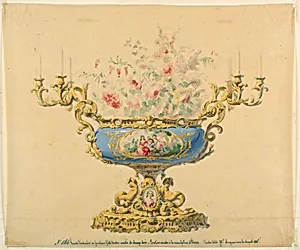
Design for a Jardiniere and Candelabrum
ca. 1855
Classification
lighting
Department
Smithsonian Collection
Museum
Smithsonian American Art Museum
Credit
Museum purchase from Pauline Riggs Noyes Fund
Accession Number
1953-206-10
Rights
Public Domain
About this artwork
Research in Progress
Art Historical Context
This elegant *Design for a Jardini and Candelabrum dating to around 1855, offers a glimpse into mid-th-century American decorative arts. Created during the Victorian era, when ornate household furnishings symbolized prosperity and refinement, it depicts a multifunctional piece combining a jardiniere—a stylish stand for flowers or plants—with a candelabrum, an elaborate branched candlestick for illumination. Such designs reflected the era's fascination with neoclassical and rococo revival motifs, blending utility with opulent decoration to grace parlors and dining rooms. Though the artist remains unknown and the medium is yet to be specified, the work's classification as lighting highlights its innovative role in domestic lighting before widespread electricity. Acquired through the Pauline Riggs Noyes Fund and housed in the Smithsonian American Art Museum's collection, it exemplifies the craftsmanship of American designers responding to industrial advancements and European influences. Research into this piece is ongoing, inviting us to ponder its place in the evolving story of American design. Visitors might imagine it flickering with candlelight amid blooming greenery, a perfect emblem of Victorian domestic splendor.
About the Artist
Unknown
The artist designated as "Unknown" in our virtual museum's collection exemplifies a poignant chapter in art history: creators whose identities have faded into obscurity despite the enduring power of their work. With only one known artwork attributed to them in our holdings, this figure represents countless anonymous hands that shaped visual culture across centuries. Museums worldwide, including th...