
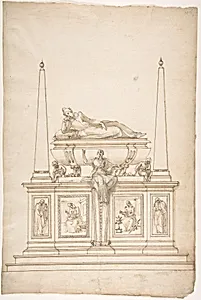
Design for a Lady's Tomb
Medium
Black chalk, pen and brown ink, brush and brown wash
Dimensions
sheet: 17 5/16 x 11 9/16 in. (43.9 x 29.3 cm)
Classification
Drawings
Department
Drawings and Prints
Museum
Metropolitan Museum of Art, New York, NY
Credit
The Elisha Whittelsey Collection, The Elisha Whittelsey Fund, 1949
Accession Number
49.19.32
Rights
Public Domain
Tags
Art Historical Context
This exquisite *Design for a Lady's* from 16th-century France captures the grandeur of Renaissance funerary architecture. Attributed to the circle of Jacques Androuet Cerceau—a pioneering French architect and engraver known for his influential pattern books—or an anonymous contemporary, the drawing depicts an elaborate tomb structure adorned with human figures, evoking classical motifs adapted to aristocratic memorials. During this era, such designs symbolized eternal legacy and piety, blending Gothic traditions with emerging Italian Renaissance influences like symmetry, columns, and sculpted effigies. Rendered in black chalk for fluid underdrawings, pen and brown ink for precise lines, and brush with brown wash for dramatic shading, the medium exemplifies the technical virtuosity of period draftsmen. These mixed techniques allowed architects to convey three-dimensionality and texture on paper, serving as proposals for patrons or workshops. Measuring 17 5/16 x 11 9/16 inches, its intimate scale belies its monumental vision. Housed in the Metropolitan Museum of Art's Drawings and Prints department, this work highlights the collaborative artistry of Renaissance design, where drawings bridged imagination and stone. It invites us to ponder the opulent world of 16th-century nobility, where even death was a canvas for splendor.