
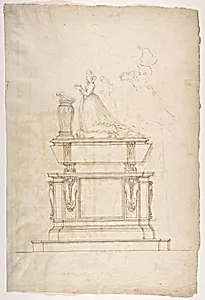
Design for a Lady's Tomb
Medium
Black chalk, pen and brown ink, brush and brown wash
Dimensions
sheet: 17 1/16 x 11 7/16 in. (43.4 x 29 cm)
Classification
Drawings
Department
Drawings and Prints
Museum
Metropolitan Museum of Art, New York, NY
Credit
The Elisha Whittelsey Collection, The Elisha Whittelsey Fund, 1949
Accession Number
49.19.27
Rights
Public Domain
Tags
Art Historical Context
This exquisite 16th-century drawing, *Design for a Lady's*, attributed to the renowned French architect Jacques Androu du Cerceau or an anonymous contemporary, captures the elegance of Renaissance funerary architecture. Du Cerceau, a master of ornamental design active during France's Fontainebleau School era, was celebrated for his intricate engravings and pattern books that influenced châteaux and monuments across Europe. Created amid the Italian Renaissance's spread northward, this sheet exemplifies the period's fusion of classical motifs—columns, pediments, and sculpted figures—with French Gothic flourishes, tailored for a noblewoman's eternal resting place. Executed in black chalk, pen and brown ink, and brush with brown wash on a modest 17 x 11-inch sheet, the medium allowed for precise linework and subtle tonal modeling. These techniques, common in architectural drafts of the time, enabled artists to convey depth, shadow, and materiality, turning a preparatory sketch into a persuasive vision for stonemasons and patrons. Housed in the Metropolitan Museum of Art's Drawings and Prints department, this work highlights the era's cultural reverence for elaborate tombs, which served as public displays of piety, status, and humanism. It invites us to ponder the artistry behind memorials that blended sorrow with splendor, preserving a lady's legacy in stone.