
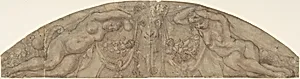
Design for a Lunette
16th century
Medium
Pen and brown ink, over black chalk, brown wash
Dimensions
3-7/8 x 10-3/16 in. (9.8 x 25.9 cm)
Classification
Drawings
Department
Drawings and Prints
Museum
Metropolitan Museum of Art, New York, NY
Credit
Gift of Cornelius Vanderbilt, 1880
Accession Number
80.3.330
Rights
Public Domain
Tags
Art Historical Context
This delicate 16th-century Italian, titled *Design for a Lunette captures the Renaissance fascination with ornate architectural decoration. Created anonymously by an Italian artist, it served as a preparatory sketch for a lunette—a semi-circular panel often placed above doors or windows in palaces and churches. Rendered in pen and brown ink over black chalk, with subtle brown wash for depth, the small sheet (just under 4 by 10 inches) exemplifies precision of workshop drawings from the period. The composition likely features cascading garlands of fruit and foliage, expressive faces, and graceful female nudes, evoking the playful grotesques and mythological motifs popularized during the High Renaissance and Mannerism. These elements drew inspiration from ancient Roman frescoes rediscovered in the 15th century, blending natural abundance with human form to adorn opulent interiors. Housed in the Metropolitan Museum of Art's Department of Drawings and Prints, this work was a generous gift from Cornelius Vanderbilt in 1880. Its survival highlights the era's innovative draftsmanship techniques, where chalk provided loose underdrawing, ink added crisp lines, and wash created atmospheric shading—essential for translating ideas into fresco or stucco masterpieces. A window into Italy's artistic workshops, it invites us to imagine the vibrant spaces it once helped envision.