
Design for a Machine
18th century
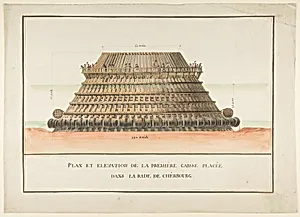
Medium
Pen and brown ink, watercolor. Dimensions in pieds given on each side of machine.
Dimensions
sheet: 13 15/16 x 19 5/8 in. (35.4 x 49.8 cm)
Classification
Drawings
Department
Drawings and Prints
Museum
Metropolitan Museum of Art, New York, NY
Credit
The Elisha Whittelsey Collection, The Elisha Whittelsey Fund, 1962
Accession Number
62.600.594
Rights
Public Domain
Tags
Art Historical Context
This intriguing 18th-century French, titled *Design for a Machine*, a glimpse into the Enlightenment-era fascination with mechanical innovation. Created anonymously by a skilled draftsman, it depicts a complex apparatus—likely an early industrial or scientific device—with meticulous precision. The sheet measures 13 15/16 x 19 5/8 inches (35.4 x 49.8 cm), and notably, the dimensions are annotated in *pieds* (the French foot, roughly 13 inches), a period-specific unit that underscores its authenticity as a working blueprint from pre-Revolutionary France. Rendered in pen and brown ink with watercolor washes, the technique highlights the artist's engineering prowess: fine ink lines delineate components, while subtle watercolors add depth and functionality, making the machine's form vivid and practical. Such drawings were vital in workshops and academies, bridging art and science during a time when inventors like Jacques de Vaucanson pioneered automata and machinery. Housed in the Metropolitan Museum of Art's Drawings and Prints department since 1962, thanks to The Elisha Whittelsey Collection, this piece exemplifies how anonymous technical sketches capture the intellectual fervor of 18th-century Europe. Visitors will appreciate its blend of artistry and ingenuity, a testament to the era's drive toward progress.
About the Artist
Anonymous, French, 18th century · 1700–1800
The artist known as Anonymous, French, 18th century, represents a collective of unidentified talents active roughly between 1700 and 1800, a period of profound artistic evolution in France from the opulent Rococo to the austere dawn of Neoclassicism and Revolutionary fervor. Little is documented about their personal training or mentors, as their anonymity obscures individual biographies, though th...