
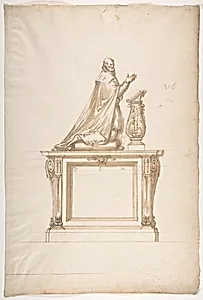
Design for a Man's Tomb
Medium
Black chalk, pen and brown ink, brush and brown wash
Dimensions
sheet: 17 3/8 x 11 5/8 in. (44.1 x 29.6 cm)
Classification
Drawings
Department
Drawings and Prints
Museum
Metropolitan Museum of Art, New York, NY
Credit
The Elisha Whittelsey Collection, The Elisha Whittelsey Fund, 1949
Accession Number
49.19.25
Rights
Public Domain
Tags
Art Historical Context
This exquisite *Design for a Man's Tomb*, attributed to the anonymous French artist Jacques Androuet du Cer in the 16th century offers a glimpse into Renaissance architectural ambition. Du Cerceau, a prolific architect and engraver, celebrated for his intricate designs of buildings, ornaments, and funerary monuments, blending classical motifs with French Gothic remnants. Created on a modest sheet measuring 17 3/8 x 11 5/8 inches, this drawing likely served as a preparatory study for a grand sepulcher, evoking the era's fascination with eternal legacy through monumental stonework. Executed in black chalk, pen and brown ink, and brush with brown wash, the work exemplifies the period's drafting techniques. The precise ink lines define structural elements like columns, arches, and sculpted figures, while chalk and wash add depth and shadow, mimicking the play of light on marble. Such mixed-media drawings were essential tools for patrons—nobles or clergy—commissioning tombs that asserted social status amid the religious upheavals of the French Wars of Religion. Housed in the Metropolitan Museum of Art's Drawings and Prints department, this piece highlights the cultural importance of tombs as status symbols in 16th-century France, where death was staged with theatrical grandeur. Visitors will appreciate its delicate artistry, a testament to the Renaissance revival of antiquity in everyday design.