
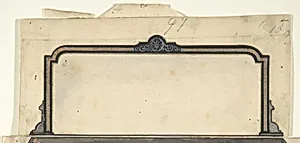
Design for a Mirror to go over a Cabinet
19th century
Medium
Pen and ink and watercolor
Dimensions
sheet: 2 15/16 x 6 1/2 in. (7.4 x 16.5 cm)
Classification
Drawings|Ornament & Architecture
Department
Drawings and Prints
Museum
Metropolitan Museum of Art, New York, NY
Credit
The Elisha Whittelsey Collection, The Elisha Whittelsey Fund, 1959
Accession Number
59.608.70(20b)
Rights
Public Domain
Tags
Art Historical Context
This delicate 19th-century design, created anonymously by a British artist, depicts an elegant mirror intended to crown a cabinet, a common feature in Victorian-era interiors. Rendered in pen and ink with watercolor on a modest sheet measuring just 2 15/16 x 6 1/2 inches, it exemplifies the precision of ornamental draftsmanship. Housed in the Metropolitan Museum of Art's Drawings and Prints department as part of The Elisha Whittelsey Collection, this work highlights the meticulous planning behind decorative furnishings. In 19th-century Britain, such designs were essential for cabinetmakers and architects crafting harmonious domestic spaces. Mirrors like this one amplified light and grandeur in parlors, serving both functional and symbolic roles as emblems of refinement and prosperity. The classification under Ornament & Architecture underscores its place in the decorative arts tradition, where symmetry and intricate detailing reflected broader neoclassical and emerging eclectic tastes. The artist's use of fine pen lines for structure, enhanced by subtle watercolor washes, allowed for vivid visualization of textures and proportions—techniques ideal for translating ideas from sketch to crafted reality. Though anonymous, this piece offers a glimpse into the collaborative world of design, inviting us to appreciate the unsung creativity behind everyday elegance.
About the Artist
Anonymous, British, 19th century · 1800–1900
**Anonymous, British, 19th century** is not the name of a single individual but a standard museum attribution used for works whose creators remain unidentified yet are clearly British and date to the 1800s. Major institutions, including the Metropolitan Museum of Art, employ this designation for hundreds of drawings, prints, designs, and decorative studies that lack signatures or firm documentary ...