
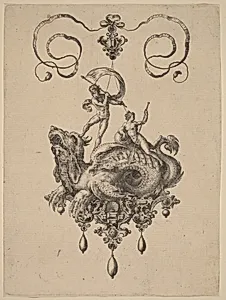
Design for a Pendant with a Sea-Monster Carrying Thetis and a Man with a Sail
Medium
engraving
Classification
Department
CG-E
Museum
National Gallery of Art, Washington, D.C.
Credit
Rosenwald Collection
Accession Number
1943.3.2804
Rights
Public Domain
Art Historical Context
In the late Renaissance era, Flemish engraver Hans Collaert the Elder crafted this intricate *Design for a Pendant with Sea-Monster Carrying The and a Man with a* in 1582. Collaert, a master of the Antwerp printmaking school, specialized in detailed reproductive engravings that served as blueprints for luxury objects like jewelry. This print, now in the National Gallery of Art's Rosen Collection, captures a dynamic mythological scene: the sea nymph Thetis borne by a fantastical sea-monster, accompanied by a sailor clutching a billowing sail, evoking tales from classical antiquity. Engraving, the medium here, was revolutionary for its precision—lines incised into a copper plate allowed jewelers to replicate elaborate designs with fidelity. Such prints democratized high art, bridging Antwerp's thriving goldsmith trade with broader audiences hungry for Renaissance opulence. Collaert's fine burin work highlights swirling waves, scaly textures, and flowing drapery, blending Northern realism with Italianate mythology. This piece reflects 16th-century Europe's fascination with ancient myths, symbolizing adventure and the sea's mysteries amid expanding explorations. As a pendant design, it underscores how prints fueled the era's jewelry craze, turning wearers into living canvases of humanism and wonder.