
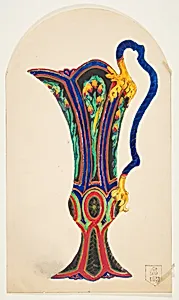
Design for a Pitcher
ca. 1857
Medium
Pen and black ink, watercolor.
Dimensions
sheet: 10 1/2 x 6 1/8 in. (26.7 x 15.6 cm)
Classification
Drawings
Department
Drawings and Prints
Museum
Metropolitan Museum of Art, New York, NY
Credit
The Elisha Whittelsey Collection, The Elisha Whittelsey Fund, 1962
Accession Number
62.659.79
Rights
Public Domain
Tags
Art Historical Context
This delicate "Design for a Pitcher," by an anonymous French artist around 1857, offers a glimpse into the elegant world of 19th-century decorative arts. Rendered on a modest sheet measuring 10 1/2 x 6 1/8 inches, the drawing features intricate floral motifs—likely inspired by nature's bounty—adorning the form of a graceful pitcher. Such designs were essential blueprints for artisans crafting luxury household items, blending functionality with ornamental beauty during France's Second Empire era, time of opulent design influenced by historicism and emerging industrial production. The medium of pen and black ink with watercolor highlights the precision of the artist's technique: fine ink lines define the pitcher's contours and swirling flower patterns, while subtle watercolor washes add depth and vibrancy, evoking porcelain or silver prototypes. This combination allowed designers to convey texture, light, and color vividly, bridging the gap between sketch and finished object. Housed in the Metropolitan Museum of Art's Drawings and Prints department as part of The Elisha Whittelsey Collection, this anonymous work underscores the collaborative spirit of 19th-century French workshops, where floral symbolism represented abundance and refinement in everyday life. Visitors will appreciate how such preparatory drawings fueled the era's passion for beautifully crafted domestic wares.
About the Artist
Anonymous, French, 19th century · 1800–1900
**Anonymous, French, 19th Century (ca. 1800–1900)** The artist cataloged as Anonymous, French, 19th century embodies the enigmatic yet essential contributions of unidentified creators to France's vibrant 19th-century art world. Active roughly between 1800 and 1900, this figure—or potentially collective workshop—produced a diverse array of works amid the nation's transition from Neoclassicism thro...