
Design for a plasterwork bracket
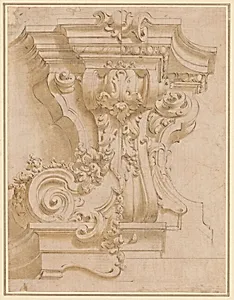
Medium
Pen and brown ink with brown wash
Dimensions
7 x 5 5/16 in. (17.8 x 13.5 cm)
Classification
Drawings
Department
Drawings and Prints
Museum
Metropolitan Museum of Art, New York, NY
Credit
Gift of William Rieder, 2009
Accession Number
2009.465.19
Rights
Public Domain
Tags
Art Historical Context
This delicate drawing, titled *Design for a Plasterwork*, hails from Bologna, Italy, around 1700, created by an anonymous artist from the vibrant Bolognese school of the early 18th century. Bologna was a hub of Baroque innovation during this period, where architects and designers crafted elaborate ornamental elements to adorn palaces, churches, and grand interiors. Such brackets—curved supports often used to hold shelves, balconies, or sculptures—were prized for their scrolling forms and intricate detailing, embodying the era's love for dynamic movement and theatrical flourish. Executed in pen and brown ink heightened with brown wash on a modest 7 x 5 5/16-inch sheet, the work showcases precise linework to define contours and subtle shading to suggest volume and light, techniques ideal for translating ideas from paper to three-dimensional plaster. These preparatory sketches were essential tools for artisans, bridging the gap between concept and execution in the workshops of Italy's decorative arts scene. Today, housed in the Metropolitan Museum of Art's Drawings and Prints department (gift of William Rieder, 2009), this anonymous gem offers a window into the unsung craftsmanship of Baroque design, reminding us how everyday architectural details elevated spaces into works of art.