
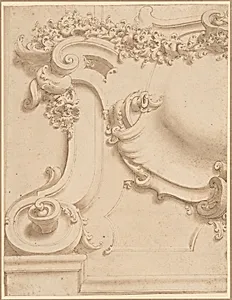
Design for Plasterwork Cartouche
Medium
Pen and brown ink with brown wash
Dimensions
11 7/16 x 11 3/4 in. (29 x 29.8 cm)
Classification
Drawings
Department
Drawings and Prints
Museum
Metropolitan Museum of Art, New York, NY
Credit
Gift of William Rieder, 2009
Accession Number
2009.465.16
Rights
Public Domain
Tags
Art Historical Context
Welcome to the intricate world of Baroque decorative arts! This *Design for Plasterwork Cartouche*, created around 1700 by an anonymous Bolognese artist, captures the exuberant spirit of late 17th-century Italy. Hailing from Bologna—a hub of architectural innovation and ornate craftsmanship—the drawing served as a blueprint for elaborate stucco ornaments. Cartouches like this, often oval or scrolling frames, adorned palaces, churches, and grand interiors, framing coats of arms, inscriptions, or allegorical motifs with playful flourishes. Executed in pen and brown ink with brown wash over 11 7/16 x 11 3/4 inches (29 x 29.8 cm), the medium highlights the precision of preparatory sketches. Fine ink lines define dynamic curves and volutes, while subtle washes add depth and shadow, mimicking the three-dimensional swell of molded plaster. This technique was essential for architects and decorators, allowing them to visualize textures and light play before costly execution. Now in the Metropolitan Museum of Art's Drawings and Prints department (gift of William Rieder, 2009), this anonymous gem reveals Bologna's enduring legacy in *scagliola* and stucco work, bridging painting and architecture in the Baroque era. It invites us to imagine opulent salons alive with illusionistic splendor!