
Design for a Porcelain Candelabra with Nine Branches
19th century
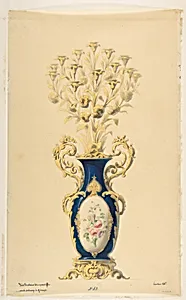
Medium
Graphite, watercolor, gouache, and gold gilt
Dimensions
sheet: 18 7/8 x 11 7/16 in. (47.9 x 29.1 cm)
Classification
Drawings
Department
Drawings and Prints
Museum
Metropolitan Museum of Art, New York, NY
Credit
The Elisha Whittelsey Collection, The Elisha Whittelsey Fund, 1953
Accession Number
53.675.8
Rights
Public Domain
Tags
Art Historical Context
This elegant design for a porcelain candelabra with nine branches captures the refined decorative sensibilities of nineteenth-century France. Created by an anonymous French artist, the drawing showcases an elaborate, multi-branched form intended for a luxurious tabletop or mantelpiece piece. The inclusion of floral motifs suggests a harmonious blend of natural elegance and opulent craftsmanship, typical of the period’s interest in ornate, nature-inspired ornamentation for domestic interiors. Executed in graphite, watercolor, gouache, and gold gilt on a sheet measuring nearly nineteen by eleven inches, the work demonstrates the meticulous process behind porcelain production. Graphite provided the initial structure, while layers of watercolor and opaque gouache allowed the artist to simulate the luminous qualities of glazed porcelain. Touches of gold gilt highlight the intended metallic accents, offering clients or manufacturers a vivid preview of the finished object’s splendor. As part of the Metropolitan Museum’s Drawings and Prints collection, this piece illuminates the collaborative world of design and manufacture in the 1800s. Such preparatory works were essential for translating artistic visions into tangible luxury goods, reflecting broader cultural values of refinement and technical innovation in the decorative arts.
About the Artist
Anonymous, French, 19th century · 1800–1900
**Anonymous, French, 19th Century (ca. 1800–1900)** The artist cataloged as Anonymous, French, 19th century embodies the enigmatic yet essential contributions of unidentified creators to France's vibrant 19th-century art world. Active roughly between 1800 and 1900, this figure—or potentially collective workshop—produced a diverse array of works amid the nation's transition from Neoclassicism thro...