
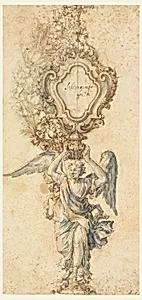
Design for a Reliquary
Classification
furniture
Department
Smithsonian Collection
Museum
Smithsonian American Art Museum
Credit
Museum purchase through gift of various donors and from Eleanor G. Hewitt Fund
Accession Number
1938-88-2571
Rights
Public Domain
About this artwork
Research in Progress
Art Historical Context
Francesco Solimena (1657–1747), a leading figure of the Neapolitan Baroque crafted this *Design for a Reliqu* around 1675–1700, during his early career in southern Italy. Trained in the dramatic style of masters like Luca Giordano, Solena was renowned for his theatrical compositions, swirling drapery, and emotional intensity, often seen in grand frescoes and altarpieces churches. This preparatory drawing reflects the era's Counter-Reformation fervor, where religious objects were designed to inspire awe and devotion amid Catholic Italy's artistic splendor. Reliquaries—elaborate containers for saints' relics—were prized as both sacred furniture and status symbols for ecclesiastical patrons. Classified here as furniture, Solimena's design likely sketches an intricate, sculptural form blending architecture and figural elements, typical of Baroque opulence. Though the medium remains unidentified amid ongoing research, such designs were commonly rendered in pen, ink, and wash to convey texture and light on gilded surfaces. Acquired by the Smithsonian American Art Museum through generous donors, this work offers a glimpse into the collaborative world of 17th-century Italian workshops, where painters like Solimena bridged art and craft to elevate the divine. A testament to Baroque ingenuity, it invites us to imagine the shimmering reliquary it envisioned, alive with spiritual drama.