
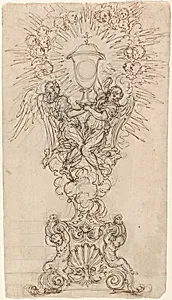
A Monstrance with Two Angels Supporting a Chalice
1651 to 1700
Medium
black chalk and pen and brown ink, partially squared in black chalk, on laid paper
Dimensions
overall: 42.3 x 23.7 cm (16 5/8 x 9 5/16 in.)
Classification
Drawing
Department
CG-E
Museum
National Gallery of Art, Washington, D.C.
Credit
Ailsa Mellon Bruce Fund
Accession Number
1995.15.1
Rights
Public Domain
Art Historical Context
In the opulent world of 17th-century Italian Baroque art, Giovanni Battistaoggini's *A Monstrance with Two Angels Supporting a Chal* (ca. 1651–1700) captures the era's fervor for religious grandeur. Foggini, a Florentine sculptor and architect favored by the Medici court, crafted this preparatory drawing to envision a sacred vessel—a monstrance—used in Catholic liturgy to display the consecrated host. Flanked by ethereal angels bearing a chalice, the design evokes divine mystery and theatrical drama, hallmarks of Baroque devotion that aimed to inspire awe in worshippers. Executed on laid paper with black chalk for soft modeling, pen and brown ink for precise lines, and partial squaring in black chalk, the sheet measures 42.3 x 23.7 cm. This technical virtuosity reveals Foggini's process: the grid suggests enlargement for sculpture or silverwork, blending fluidity of chalk shadows with ink's crisp contours to convey three-dimensionality. Such drawings bridged imagination and execution in workshops, preserving designs for grand ecclesiastical commissions. Today, housed in the National Gallery of Art (Ailsa Mellon Bruce Fund, Department CG-E), this work offers a window into Baroque Italy's fusion of art and faith, highlighting how sketches like Foggini's fueled the Counter-Reformation's visual splendor.
About the Artist
Giovanni Battista Foggini · 1652–1725
**Giovanni Battista Foggini** (1652–1725) was a leading Italian sculptor and architect of the late Baroque period, born in Florence within the Grand Duchy of Tuscany. He began his career under the patronage of the Medici family, who sponsored his artistic training. In 1673, at the age of 21, Cosimo III de' Medici sent the young Foggini to Rome to join the newly founded Accademia Fiorentina, where ...