
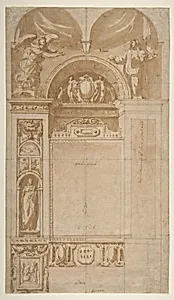
Design for a Reredos or Frame and Setting for an Altar Painting
1552–1626
Medium
Pen and brown ink, brush and brown wash
Dimensions
Sheet: 15 3/16 x 8 3/4 in. (38.5 x 22.2 cm)
Classification
Drawings
Department
Drawings and Prints
Museum
Metropolitan Museum of Art, New York, NY
Credit
The Elisha Whittelsey Collection, The Elisha Whittelsey Fund, 1949
Accession Number
49.19.49
Rights
Public Domain
Tags
Art Historical Context
Cristoforo Roncalli, known as Pomarancio was a prominent Italian Mannerist artist active in late 16th- and early 17th-century Rome. This delicate drawing, titled *Design for a Rered or Frame and Setting for Altar Painting* (ca. 1552–1626), showcases his skill in architectural and figural design for sacred spaces. Created as a preparatory study, it likely served as a proposal for the ornate backdrop (reredos) behind an altar painting in a church, blending sculpted human figures with elaborate framing to enhance religious devotion during the Counter-Reformation era. Executed in pen and brown ink with brush and brown wash on a modest sheet (15 3/16 x 8 3/4 in.), the work exemplifies the precision of Renaissance draftsmanship. The brown wash adds depth and shadow, helping to visualize the three-dimensional grandeur of the altar ensemble—complete with dynamic human figures integrated into columns and pediments. Such drawings were vital tools for artists collaborating with patrons and sculptors, bridging concept to construction in opulent ecclesiastical art. Housed in the Metropolitan Museum of Art's Drawings and Prints department (The Elisha Whittelsey Collection, 1949), this piece offers a rare glimpse into the creative process behind Italy's lavish church interiors, where art amplified spiritual theater for worshippers.