
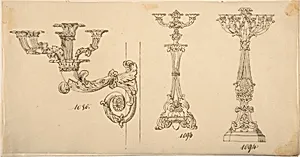
Design for a Sconce and Two Candelabras
19th century
Medium
Pen and brown ink
Dimensions
sheet: 5 13/16 x 11 5/16 in. (14.8 x 28.7 cm)
Classification
Drawings
Department
Drawings and Prints
Museum
Metropolitan Museum of Art, New York, NY
Credit
Rogers Fund, 1966
Accession Number
66.631.87
Rights
Public Domain
Tags
Art Historical Context
This delicate pen and brown ink drawing, titled *Design for a Sconce and Candelabras*, offers a glimpse into the refined world of 19th-century French decorative. Created by an anonymous, it sketches elegant lighting fixtures—a wall-mounted sconce and a pair of freestanding candelabras— intended for opulent interiors of grand homes or public spaces. The precise lines capture the ornate curves and symmetrical forms typical of the era's neoclassical and Empire influences, blending functionality with lavish ornamentation. Rendered on a modest sheet measuring 5 13/16 x 11 5/16 inches, the work exemplifies the preparatory sketches used by designers and workshops to plan metalwork or bronze castings. Pen and brown ink was a favored medium for such technical drawings, allowing sharp detailing and subtle shading to convey texture and light play—essential for visualizing how candle flames would dance across gilded surfaces. Acquired through the Rogers Fund in 1966, this piece from the Metropolitan Museum of Art's Drawings and Prints collection highlights the unsung role of anonymous artisans in shaping France's legacy of luxury design. It reminds us how everyday objects like lighting became canvases for artistic ingenuity during a century of rapid industrialization and stylistic revival.
About the Artist
Anonymous, French, 19th century · 1800–1900
**Anonymous, French, 19th Century (ca. 1800–1900)** The artist cataloged as Anonymous, French, 19th century embodies the enigmatic yet essential contributions of unidentified creators to France's vibrant 19th-century art world. Active roughly between 1800 and 1900, this figure—or potentially collective workshop—produced a diverse array of works amid the nation's transition from Neoclassicism thro...