
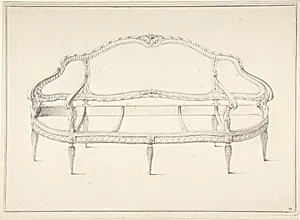
Design for a Settee
ca. 1770–90
Medium
Graphite
Dimensions
10 3/8 x 14 in. (26.3 x 35.6 cm)
Classification
Drawings
Department
Drawings and Prints
Museum
Metropolitan Museum of Art, New York, NY
Credit
Gift of Raphael Esmerian, 1961
Accession Number
61.680.4.4
Rights
Public Domain
Tags
Art Historical Context
This delicate graphite drawing, titled *Design for a Sette*, captures the elegance of late 18th-century French design by an anonymous artist around 1770–90. Rendered with precise lines on paper (10 3/8 x 14 in.), it sketches a graceful settee—a compact sofa ideal for intimate salons—showcasing the era's shift from ornate Rococo curves to more refined Neoclassical forms. Such preparatory drawings were essential tools for artisans, bridging the gap between concept and craftsmanship in royal workshops like those of the Gobelins or Sèvres. Graphite's subtle shading allowed designers to convey texture, proportion, and ornamentation with remarkable clarity, highlighting the settee's cabriole legs, upholstered back, and scrolling arms that evoked luxury and comfort. In pre-Revolutionary France, furniture like this symbolized aristocratic refinement, adorning Versailles-inspired interiors amid Enlightenment ideals of harmony and symmetry. A generous gift to the Metropolitan Museum of Art from Raphael Esmerian in 1961, this anonymous gem offers a window into the collaborative world of decorative arts, reminding us how drawings fueled the opulent legacy of French design.
About the Artist
Anonymous, French, 18th century · 1700–1800
The artist known as Anonymous, French, 18th century, represents a collective of unidentified talents active roughly between 1700 and 1800, a period of profound artistic evolution in France from the opulent Rococo to the austere dawn of Neoclassicism and Revolutionary fervor. Little is documented about their personal training or mentors, as their anonymity obscures individual biographies, though th...