
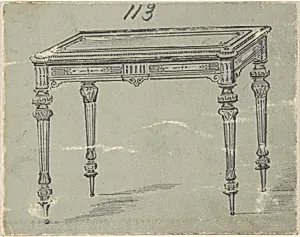
Design for a Small Rectangular Table with Greek Ornament
19th century
Medium
Graphite on gray ground
Dimensions
sheet: 3 5/8 x 4 9/16 in. (9.2 x 11.6 cm)
Classification
Drawings|Ornament & Architecture
Department
Drawings and Prints
Museum
Metropolitan Museum of Art, New York, NY
Credit
The Elisha Whittelsey Collection, The Elisha Whittelsey Fund, 1959
Accession Number
59.608.70(29)
Rights
Public Domain
Tags
Art Historical Context
This delicate 19th-century drawing titled *Design for a Small Rectangular Table with Greek Ornament*, captures the elegance of British neoclassical design by an anonymous artist. Created on a modest sheet of gray-ground paper measuring just 3⅝ × 4⁹/₁₆ inches, it showcases a compact rectangular table adorned with intricate Greek-inspired motifs—think acanthus leaves, scrolls, and geometric friezes that evoke ancient antiquity. Housed in the Metropolitan Museum of Art's Drawings and Prints department, this piece from The Elisha Whittelsey Collection highlights the era's fascination with classical revival. In 19th-century Britain, the Greek Revival movement flourished amid growing archaeological interest in ancient Greece and Rome, influencing furniture makers like Thomas Hope and George Bullock. Such designs blended functionality with ornamentation, turning everyday tables into statements of refined taste for the emerging middle class. Graphite on gray ground was a favored technique, allowing artists to achieve subtle tonal contrasts and shadows with minimal lines, mimicking the look of polished metal or carved wood. This anonymous sketch offers a window into the creative process behind Regency and Victorian furnishings, reminding us how pencil strokes on prepared paper could inspire real-world luxury. A charming testament to design's enduring legacy!
About the Artist
Anonymous, British, 19th century · 1800–1900
**Anonymous, British, 19th century** is not the name of a single individual but a standard museum attribution used for works whose creators remain unidentified yet are clearly British and date to the 1800s. Major institutions, including the Metropolitan Museum of Art, employ this designation for hundreds of drawings, prints, designs, and decorative studies that lack signatures or firm documentary ...