
Design for a Soup Tureen with Pig on Top
19th century
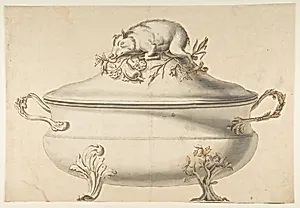
Medium
Pen and brown ink with gray wash on laid paper
Dimensions
sheet: 13 5/16 x 19 3/8 in. (33.8 x 49.2 cm)
Classification
Drawings
Department
Drawings and Prints
Museum
Metropolitan Museum of Art, New York, NY
Credit
The Elisha Whittelsey Collection, The Elisha Whittelsey Fund, 1949
Accession Number
49.19.51
Rights
Public Domain
Tags
Art Historical Context
This charming 19th-century drawing captures a whimsical design for a soup tureen topped with a pig, reflecting the playful spirit often found in French decorative arts of the period. Created with pen and brown ink and gray wash on laid paper, the sketch likely served as a preparatory study for a functional yet decorative serving piece intended for the dining table. Such designs highlight how everyday objects were elevated through imaginative ornamentation, blending utility with humor. The use of ink and wash allowed the anonymous French artist to convey both precise outlines and subtle shading, emphasizing the tureen’s sculptural form and the pig’s lively presence. This technique was common in 19th-century design drawings, offering a balance of clarity and depth that helped artisans translate ideas into metal, porcelain, or ceramic. As part of the Metropolitan Museum’s collection of drawings and prints, the work offers insight into the creative process behind tableware, where motifs like pigs may have alluded to themes of abundance or rustic charm in French culinary culture.
About the Artist
Anonymous, French, 19th century · 1800–1900
**Anonymous, French, 19th Century (ca. 1800–1900)** The artist cataloged as Anonymous, French, 19th century embodies the enigmatic yet essential contributions of unidentified creators to France's vibrant 19th-century art world. Active roughly between 1800 and 1900, this figure—or potentially collective workshop—produced a diverse array of works amid the nation's transition from Neoclassicism thro...