
Design for a Stage Set
19th century
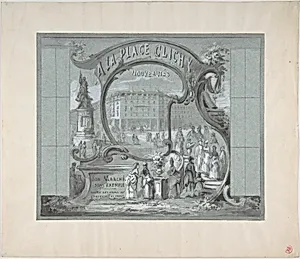
Medium
Graphite, brush and gray wash, heightened with white on blue paper
Dimensions
sheet: 7 1/2 x 9 3/16 in. (19.1 x 23.4 cm)
Classification
Drawings
Department
Drawings and Prints
Museum
Metropolitan Museum of Art, New York, NY
Credit
The Elisha Whittelsey Collection, The Elisha Whittelsey Fund, 1967
Accession Number
67.837.4
Rights
Public Domain
Tags
Art Historical Context
This delicate *Design for a Stage Set created by an anonymous French artist in 19th century, a glimpse into the theatrical imagination of the era. Rendered on blue paper—a popular choice for evoking atmospheric skies or architectural depth—the drawing measures a modest 7 1/2 x 9 3/16 inches. It belongs to the Metropolitan Museum of Art's Elisha Whittelsey Collection, highlighting its enduring value among preparatory works for the stage. In 19th-century France, theater flourished with grand operas, ballets, and plays at venues like the Paris Opéra, where elaborate scenery created illusions of palaces, landscapes, and fantastical realms. Stage designs like this one were essential blueprints, guiding carpenters, painters, and machinists to build immersive worlds that transported audiences. Though anonymous, the artist's skill captures the period's emphasis on spectacle and spatial drama, bridging fine art and performance. The medium—graphite for precise lines, brush and gray wash for tonal modeling, and white heightening for luminous highlights—demonstrates sophisticated mixed-media techniques. This approach allowed for quick yet evocative studies, balancing shadow and light to suggest depth on a flat surface. A charming window into backstage creativity, it reminds us how drawings fueled the magic of live theater.
About the Artist
Anonymous, French, 19th century · 1800–1900
**Anonymous, French, 19th Century (ca. 1800–1900)** The artist cataloged as Anonymous, French, 19th century embodies the enigmatic yet essential contributions of unidentified creators to France's vibrant 19th-century art world. Active roughly between 1800 and 1900, this figure—or potentially collective workshop—produced a diverse array of works amid the nation's transition from Neoclassicism thro...