
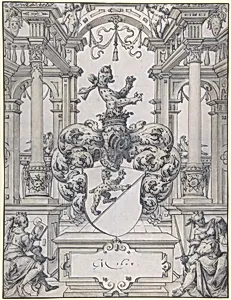
Design for a Stained Glass Window
1608
Medium
Pen and black ink, gray and light brown-gray wash
Dimensions
16 3/16 x 12 5/16 in. (41.1 x 31.2 cm)
Classification
Drawings|Ornament & Architecture
Department
Drawings and Prints
Museum
Metropolitan Museum of Art, New York, NY
Credit
Edward Pearce Casey Fund, 1994
Accession Number
1994.24
Rights
Public Domain
Tags
Art Historical Context
Christoph Murer, a prolific Swiss artist, engraver, and cartographer from Zurich (1558–1614), created this *Design for a Stained Glass Window* in 1608. Executed in pen and black ink with subtle gray and light brown-gray washes on paper (16 3/16 x 12 5/16 in.), it exemplifies the meticulous preparatory drawings used by Renaissance designers to plan vibrant stained glass panels. Housed in the Metropolitan Museum of Art's Drawings and Prints department, this work highlights Murer's versatility in ornament and architecture. The composition likely centers on heraldic motifs, featuring women, animals, and coats of arms—common elements in ecclesiastical or civic stained glass commissions. These symbols conveyed lineage, power, and piety, transforming architecture into storytelling mediums. Murer's precise ink lines define contours and details, while the delicate washes add depth and luminosity, mimicking the anticipated glow of colored glass under light. In early 17th-century Europe, such designs bridged the Renaissance and emerging Baroque styles, preserving Switzerland's rich stained glass tradition amid Reformation influences. Murer's output, including maps and glass paintings for Zurich's elite, underscores his role in blending artistry with heraldry, making public spaces vivid emblems of identity. This drawing invites us to imagine its realization: a window alive with color and symbolism.
About the Artist
Christoph Murer · 1558–1614
Christoph Murer was born in Zurich in 1558 into a dynasty of Swiss artists, the son of the glass painter Josias Murer and grandson of the celebrated painter and dramatist Jos Murer. Growing up surrounded by the craft of stained glass and the broader artistic culture of late Reformation Switzerland, he received thorough training in both glass painting and drawing, eventually becoming one of the mos...