
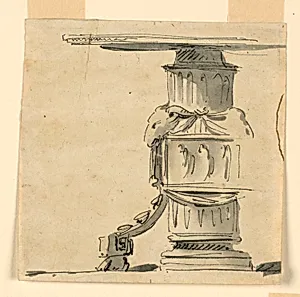
Design for a table with decorated base
Medium
furniture
Classification
furniture
Department
Smithsonian Collection
Museum
Smithsonian American Art Museum
Credit
Museum purchase through gift of various donors and from Eleanor G. Hewitt Fund
Accession Number
1938-88-2091
Rights
Public Domain
About this artwork
Research in Progress
Art Historical Context
Giuseppe Barberi, a prominent Italian architect and designer (1746–1809), created this *Design for a Table with Decorated Base* around 1780, capturing the elegance of late 18th-century Roman neoclassicism. Working in Rome during a time when artists drew inspiration from ancient Greco-Roman motifs, Barberi specialized in furniture and interior designs that blended classical symmetry with refined ornamentation. This preparatory drawing exemplifies his meticulous approach, likely intended for a luxurious table featuring an intricately embellished pedestal base—hallmarks of the period's shift from ornate Baroque styles toward cleaner, more archaeologically precise forms. As a furniture design, the work reflects the era's fascination with antiquity, fueled by archaeological discoveries at sites like Pompeii and Herculaneum. Barberi's designs influenced elite Roman patrons and helped disseminate neoclassical tastes across Europe. Though research on this specific piece is ongoing, its presence in the Smithsonian American Art Museum's collection—acquired through museum purchase and donor gifts—highlights its value as a window into Italian decorative arts. Visitors can appreciate how such blueprints bridged the gap between concept and craftsmanship, shaping the grand interiors of the Enlightenment age.