
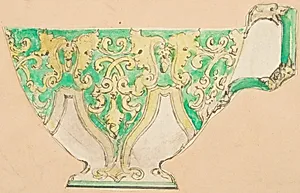
Design for a tea cup
19th century
Medium
Pen and ink and watercolor
Dimensions
sheet (irregular): 2 5/8 x 4 1/16 in. (6.7 x 10.3 cm)
Classification
Drawings
Department
Drawings and Prints
Museum
Metropolitan Museum of Art, New York, NY
Credit
The Elisha Whittelsey Collection, The Elisha Whittelsey Fund, 1962
Accession Number
62.600.244
Rights
Public Domain
Tags
Art Historical Context
This delicate "Design for a Tea Cup created by an anonymous French artist in the th century, offers a glimpse into the refined world of European decorative arts. Rendered on a small, irregular sheet measuring just 2 5/8 x 4 1/16 inches, the drawing captures the elegant form and ornate details of a teacup, likely intended for porcelain production at a renowned manufactory like Sèvres Housed in the Metropolitan Museum of Art's Drawings and Prints department as part of The Elisha Whittelsey Collection (acquired through the Elisha Whittelsey Fund in 1962), it exemplifies the meticulous planning behind everyday luxury items. Executed in pen and ink with watercolor, the medium highlights the precision of line work for contours and handles, enhanced by subtle color washes to suggest glaze or decoration. This technique was common in 19th-century design ateliers, where artists sketched prototypes for ceramics, silver, or glassware, bridging fine art and functional objects. During France's Belle Époque era, tea drinking symbolized sophistication and social ritual, making such designs culturally vital for bourgeois households. Though anonymous, this modest drawing underscores the collaborative craft of design, revealing how anonymous talents shaped tastes in domestic elegance. Visitors will appreciate its intimate scale—perfect for imagining it scaled up into a cherished heirloom.
About the Artist
Anonymous, French, 19th century · 1800–1900
**Anonymous, French, 19th Century (ca. 1800–1900)** The artist cataloged as Anonymous, French, 19th century embodies the enigmatic yet essential contributions of unidentified creators to France's vibrant 19th-century art world. Active roughly between 1800 and 1900, this figure—or potentially collective workshop—produced a diverse array of works amid the nation's transition from Neoclassicism thro...