
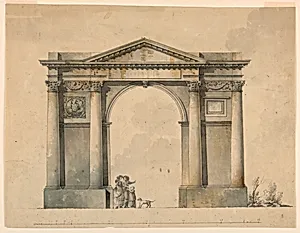
Design for a Triumpal Arch for Napoleon I, Bergamo, Italy
Medium
architecture
Classification
architecture
Department
Smithsonian Collection
Museum
Smithsonian American Art Museum
Credit
Museum purchase through gift of various donors and from Eleanor G. Hewitt Fund
Accession Number
1938-88-3743
Rights
Public Domain
About this artwork
Research in Progress
Art Historical Context
Giacomo Quarenghi (1744–1817), a leading Italian neoclassical architect renowned for his elegant designs across Europe, created this architectural drawing for a triumphal arch honoring Napoleon I in Bergamo, Italy, sometime between 1800 and 1812. Quarenghi, who spent much of his career in Russia designing imperial palaces and public buildings, brought his mastery of classical proportions and symmetry to this project, blending ancient Roman grandeur with Enlightenment ideals of order and monumentality. Triumphal arches were quintessential symbols of military victory and imperial authority during the Napoleonic era, echoing Rome's ancient arches while celebrating Bonaparte's conquests. Bergamo, a Lombard city under French influence as part of the Kingdom of Italy, would have been an ideal site for such a structure, proclaiming Napoleon's dominance in northern Italy amid his sweeping campaigns. Held in the Smithsonian American Art Museum's architecture collection (museum purchase through various donors and the Eleanor G. Hewitt Fund), this design offers a glimpse into the fusion of politics and art in the early 19th century. Though research continues, it highlights Quarenghi's skill in envisioning civic monuments that aspired to timeless glory.